hurozo Attend
First step

Set up your first agency

Create an agency, add workers, attach canon, and assign its first task.

Worker Tools

Manage worker

Tune the role and tools for this agency teammate. Graph wiring stays internal.

Tools

Loading...

Worker View

No tools selected
Team worker Untitled Agent Describe what this agent should do. HurozoAgent

Worker Chat

Describe the worker you want to add to this team, or what you want to change.
Draft JSON
{}

Teams

Teams are managed from Agency.

Connectors

Connectors

Connect services for the current agency

Loading connectors…

Agency

Team workspace

Planning

Filters

Build

Runs

Execution activity

Runs

Inspect Worker work, tool calls, reasoning summaries, and failures.

Select a run to inspect its activity.

Files

Agency files

    Documentation

    Contact Us

    New message

    To: hi@hurozo.com

    Hurozo CLI

    Terminal-first agent work

    Hurozo CLI

    The same Hurozo agent runtime, model routes, approvals, and connected tools from your shell.

    Install with Homebrew
    brew tap hurozo/hurozo-cli
    brew install hurozo-cli
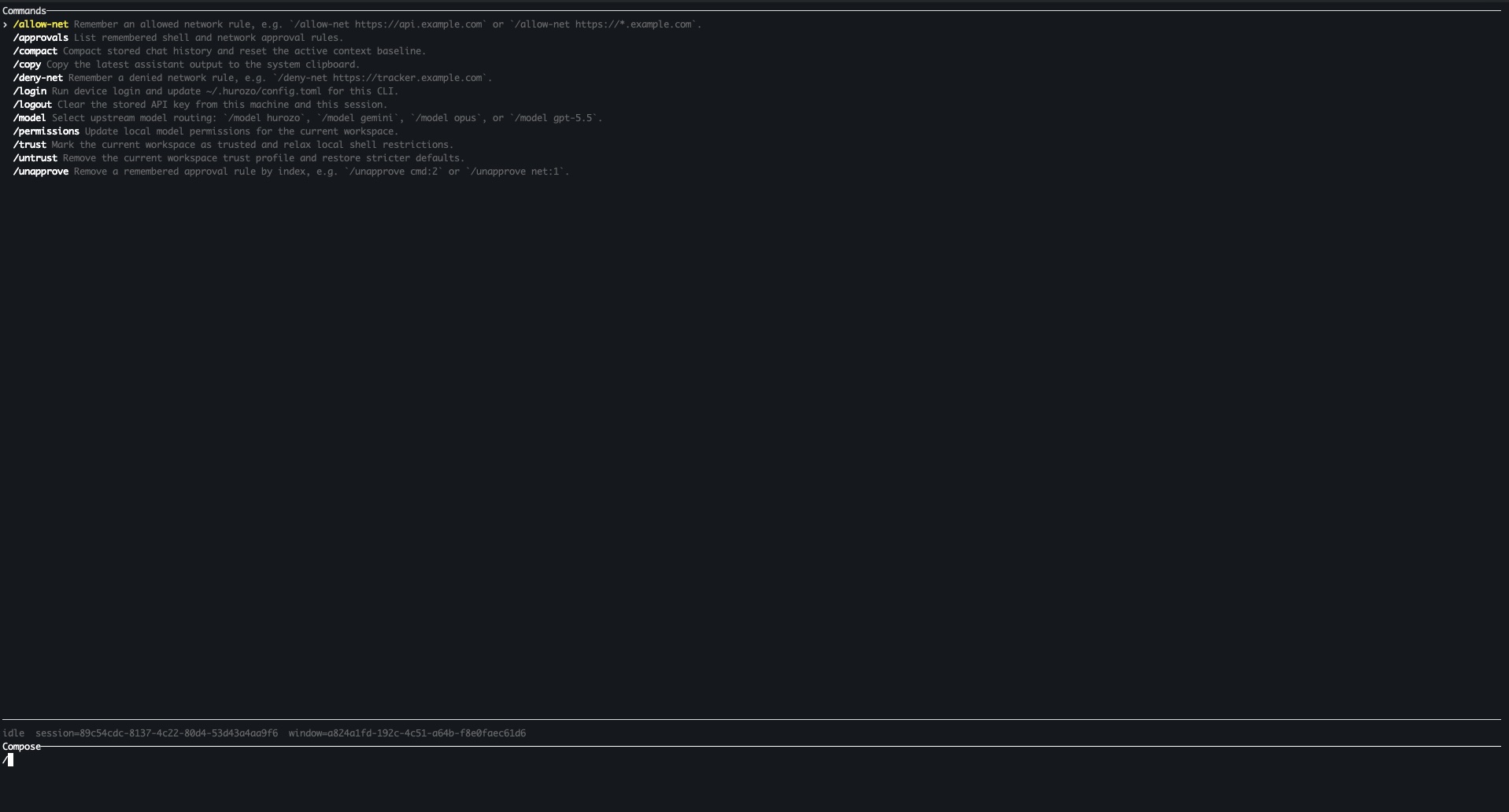
    Hurozo CLI running in a terminal

    Model routing

    Switch between Hurozo, Gemini, Opus, and ChatGPT-backed routes when your account is configured for them.

    Approvals

    Review tool permissions from the terminal and keep remembered decisions scoped to the exact operation.

    Second opinions

    Use model arbitration to ask another available route for critique, checks, or a different perspective.

    Connected tools

    Use the same account-backed connectors and skills available in Hurozo's desktop and WebCLI experiences.

    First run

    After installation, run hurozo. The CLI walks you through account authentication and any model-specific sign-in or secret setup that your selected route requires.

    Hurozo SDK

    Python agent invocation

    Hurozo SDK

    Invoke saved Hurozo agents from Python using the same API tokens, inputs, outputs, and runtime routing used by Agent Builder.

    Install
    pip install hurozo
    getting_started.pyPython
    import json
    import os
    
    from hurozo import Agent
    
    os.environ["HUROZO_API_TOKEN"] = "YOUR_API_TOKEN"
    agent = Agent("sentiment-analyser")
    inputs = {
        "prompt": "Analyze sentiment and return JSON. Text:",
        "input": "I am very happy!",
    }
    
    result = agent.run(inputs)
    print(json.dumps(result, indent=2))

    Agent lookup

    Use an agent name, saved agent id, or agent UUID. The SDK resolves the correct execution target.

    Structured inputs

    Pass a Python dictionary matching the API input keys exposed by the saved workflow.

    Hosted runtime

    Runs against Hurozo's execution endpoint, including model routing, tools, outputs, and usage accounting.

    Token setup

    Create an API token from Account settings -> Manage API Tokens, then set it as HUROZO_API_TOKEN before running scripts.

    Compare the alternatives

    The AI customer service choice you can defend.

    You are the one who has to make the case to finance, IT, and the founder. Every alternative makes you rent a black box, build a risk, or cap your growth. Attend is the one you own and can prove: EU-resident, auditable, and it never leaves a customer at a wall. Here is every option, scored on what you are actually accountable for.

    What you are accountable for

    the comparison, at a glance
    has it ~ partial, or you build it · not by default
    Helpdesk AI
    AI-native agent
    Enterprise suite
    Infra / CPaaS
    DIY build
    More people
    AAttend
    See the reasoning, hold every send before it goes
    · black box
    · black box
    ~ governed, IT-owned
    ~ you build it
    ~ only if you built it
    ~ a person does
    Gate on every send
    Own it: your model, data, and reasoning, EU-resident
    · rented
    · rented
    · rented enterprise
    · rented infra
    ~ glued together
    · n/a
    Yours to keep
    Prove every answer, shaped to the AI Act
    · not by default
    · not by default
    ~ governed, not EU
    ~ you build it
    · no record
    ~ a person, not a record
    Every run recorded
    Answer from your canon and live systems
    ~ partial
    ~ partial
    ~ workflow-bound
    ~ you build it
    · rots between re-index
    ~ a person does
    Grounded in your canon
    Answers in your brand voice, on every channel
    · not your voice
    · generic tone
    ~ workflow-bound
    ~ you build it
    · off-brand
    yes
    One voice, on brand
    Never a wall: a human exit by default
    · dead-ends
    ~ varies
    ~ varies
    ~ you build it
    · loops
    yes
    Always a way out
    Keep the knowledge when people leave
    · no
    · no
    ~ in the suite
    · no
    · walks out
    · walks out
    It lives in the canon
    Scale without a rising per-ticket bill
    · per-resolution meter
    · per-resolution meter
    · per-seat + usage
    ~ metered per message
    ~ build + upkeep
    · more headcount
    Flat fee, no meter

    Every option makes you rent a black box, build a risk, or cap your growth. Attend is the one you own and can prove. Honest scope: write-back to your connected systems is propose-and-approve, not auto-write, and voice is our newest channel.

    Four doors

    the choice, framed
    Door one

    You rented a black box

    It answers, but you cannot see why, cannot stop a bad reply before it sends, and cannot take it with you. You babysit a box you do not own.

    Door two

    You built it yourself

    A weekend stack that shone in the demo. Then it loops, makes up policy, and you spend your days reading logs to prove what it did.

    Door three

    You hit a ceiling

    People or a big suite, the wall is the same: the service cannot grow faster than your headcount, or it lives on a vendor's roadmap you will never own. Growth stalls either way.

    Door four

    You own it and prove it

    Attend. Your agent, your model, your canon, yours to keep. You see the reasoning, hold every send, and can prove every word. EU residency is on our roadmap.

    The first three are the trade the market keeps offering: rent it, build it, or cap out. The fourth is the one nobody else can hand you, because theirs are built around renting, building, or a cloud you do not control.

    Every alternative, and where it stops

    strong at, then the limit
    Alternative
    Strong at
    Where it stops
    Helpdesk AIZendesk AI, Intercom Fin, Gorgias
    Fast to switch on, lives in your helpdesk.
    Rented black box; the bill rises with volume.
    AI-native agentSierra, Decagon, Ada
    Handles support autonomously.
    Rented and usage-priced; not yours to audit.
    Enterprise suiteServiceNow, Salesforce Agentforce
    Deeply governed, IT trusts it.
    Built for IT and admins, tied to its own system.
    Infra / CPaaSTwilio, Sinch, Vonage
    The pipes for every channel.
    You still build and govern the agent.
    DIY buildn8n or Zapier plus an LLM, in-house RAG
    Cheap, full control, no vendor.
    Loops, unprovable, no human exit.
    Knowledge layerGuru, Slite, Glean
    Keeps internal answers honest.
    Governs answers; not an owned support crew that acts.
    More peoplekeep manual human service
    Human warmth and judgment.
    Does not scale; the knowledge walks out.

    Owned. Provable. Yours.

    The one no rival can assemble, because each of theirs is architected around renting, building, or a cloud you do not control.

    For the security review, the provable gate and the EU AI Act (Articles 12, 13, and 14) live on trust and security.

    See it answer a real ticket